Introduction: From Seeing to Understanding
For decades, robots were blind. In the 1960s and 1970s, researchers invested enormous effort teaching robots to see, treating visual perception as the primary challenge. Today, the challenge has fundamentally shifted. Robots can see—now they must understand what they see.
The gap between perception and understanding is vast. A camera can capture images. But understanding requires combining vision with reasoning, knowledge, and context. In 2025, this capability is advancing rapidly, enabling robots to interpret complex environments and adapt intelligently.
From Cameras to Comprehension
The Three Levels of Machine Vision
Level 1 - Raw Perception: Cameras capture pixels. Early computer vision stopped here, treating image processing as the endpoint.
Level 2 - Recognition: Modern systems identify objects, classify scenes, detect humans. This is where most current robotics applications operate.
Level 3 - Understanding: Comprehending not just what is present, but relationships, intentions, consequences, and context. This is the frontier.
What Understanding Requires
Robots reaching Level 3 must:
- Classify objects and recognize patterns
- Estimate 3D position, orientation, and dynamics
- Recognize human gestures and infer intent
- Build semantic maps of entire environments
- Reason about physical consequences of actions
- Understand social and cultural contexts
- Learn from limited examples
- Adapt to novel situations
Achieving this across diverse domains is an open challenge.
Technologies Enabling Environmental Understanding
Deep Learning Vision Models
CNN Evolution: From basic image classification to sophisticated systems performing multiple tasks simultaneously. ResNet, EfficientNet, and specialized architectures handle different vision challenges.
Vision Transformers: Increasingly popular for their global context understanding, enabling robots to relate distant scene elements.
Multimodal Learning: Combining RGB cameras with depth, thermal, and other sensors into unified models that understand environments more richly.
3D Scene Understanding
Robots need 3D models of environments, not just 2D images. Technologies enabling this:
- Depth Estimation: Inferring 3D structure from single or multiple images
- Semantic 3D Mapping: Building 3D maps where each region is labeled by type (wall, floor, furniture, human)
- Point Clouds: Dense 3D representations of environments from lidar or photogrammetry
- Scene Graphs: Representing relationships between objects
Temporal Understanding
Static scene understanding is insufficient. Robots must understand dynamics:
- How objects move
- Human activity trajectories
- Consequence prediction ("if I push this, what happens?")
- Change detection
Video understanding and RNN-based models enable temporal reasoning.
Knowledge Integration
Raw perception is limited without knowledge:
- Physics Knowledge: Understanding gravity, friction, collision
- Object Knowledge: Properties and typical use of objects
- Social Knowledge: Norms, safety, human preferences
- Causal Knowledge: Why things happen and what causes what
Modern systems increasingly incorporate knowledge through hybrid approaches combining learning with symbolic reasoning.
Key Technologies for Robot Understanding
Semantic Segmentation
Pixel-level scene understanding where every pixel is categorized (person, wall, furniture, floor). Modern systems achieve 85%+ accuracy on complex indoor scenes, enabling rich environmental understanding.
Panoptic Segmentation
Advanced systems perform both semantic segmentation (categories) and instance segmentation (individual objects) simultaneously, providing detailed scene comprehension.
Object Relationship Understanding
Robots must understand not just what objects exist, but their relationships:
- "Person is sitting on chair"
- "Cup is on table"
- "Hand is grasping object"
Graph neural networks and relational reasoning models enable this.
Action Affordance Understanding
Objects afford different actions. A chair is for sitting, a cup for drinking. Robots learning affordances can interact with novel objects intelligently, inferring appropriate interactions from learned patterns.
Real-World Applications: Robots That Understand
Collaborative Manufacturing
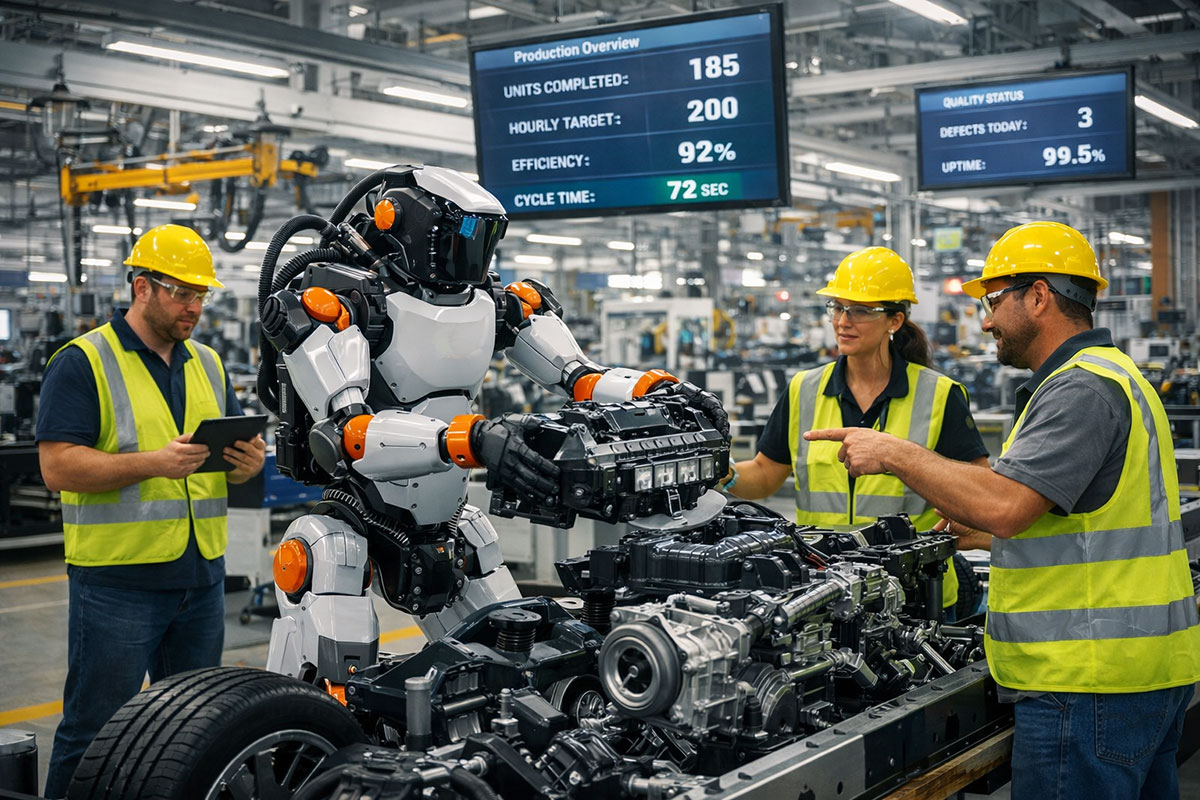
Robots working alongside humans must understand human intentions from gestures, maintain awareness of human safety needs, and communicate intentions clearly.
Assistive Robotics
Robots assisting elderly or disabled individuals must understand needs, preferences, and safety requirements. This requires rich environmental understanding combined with social intelligence.
Autonomous Delivery and Navigation
Autonomous systems navigating public spaces must understand complex scenes: distinguish humans from objects, understand traffic patterns, predict pedestrian behavior.
Search and Rescue
Robots searching disaster zones must understand damaged environments, locate victims, assess stability—all while operating in unpredictable conditions.
Scientific Research
Robots exploring caves, deep ocean, or extraterrestrial environments must understand novel, complex scenes and gather scientifically meaningful data.
Challenges on the Path to True Understanding
Generalization
Systems trained in specific environments often fail dramatically in new contexts. Achieving robust generalization remains elusive.
Long-Tail Events
Robots must handle rare situations gracefully. This requires either massive training data or sophisticated reasoning capabilities.
Common Sense Knowledge
Humans understand physics, causality, and consequences intuitively. Encoding this knowledge into machines remains challenging.
Explainability
When robots make safety-critical decisions, understanding their reasoning becomes essential. Deep neural networks are notoriously opaque.
Real-Time Constraints
Robots often need decisions in milliseconds. This limits computational complexity available for sophisticated reasoning.
The Future: From Understanding to Wisdom
Continual Learning
Robots improving through deployment experience, adapting to new environments and situations continuously.
Transfer Learning
Learning in one domain and applying to novel domains with minimal retraining.
Causal Reasoning
Moving beyond correlation to causal understanding, enabling robots to predict consequences and reason about interventions.
Human-Robot Collaboration
Robots as partners understanding human intentions, preferences, and constraints, working seamlessly alongside humans.
Conclusion: Understanding as Foundation
Raw perception is just the beginning. True robotic intelligence requires understanding—comprehending environments, inferring human intentions, reasoning about consequences, and adapting to novel situations. The gap between current capabilities and true understanding remains substantial, but progress accelerates.
Organizations leading robotics will be those that invest in understanding, not just perception. Robots that see are useful. Robots that understand will be transformative.
Explore further: Computer Vision in Robotics, Learning Robotics, Complete Robotics Guide.