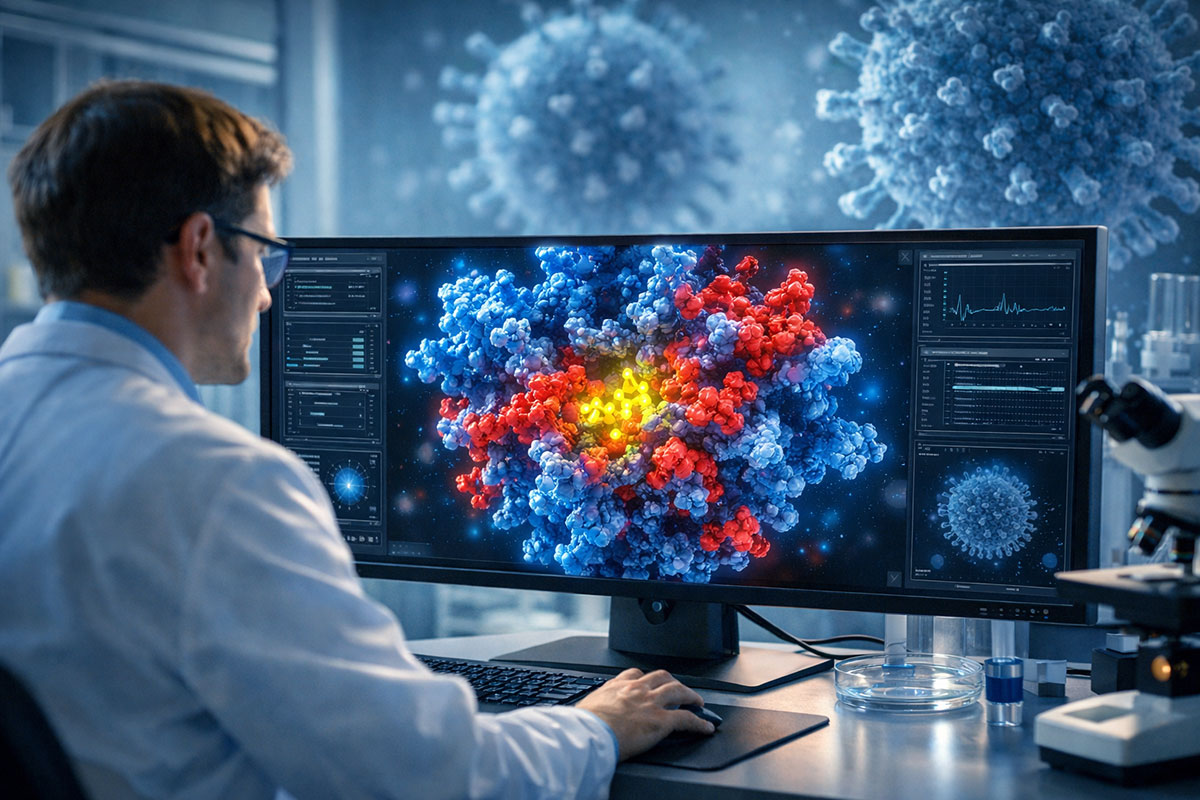
The Medical AI Breakthrough You Need to Know About
On December 15, 2025, Washington State University researchers announced something that could fundamentally change how we fight viral infections. Using artificial intelligence and computational modeling, they identified a single molecular weak point in herpes viruses that, when blocked, completely prevents the virus from infecting healthy cells. This isn't a minor tweak in medical science—this is a potential game-changer that could reshape antiviral treatment for decades to come.
The discovery feels almost too good to be true: a single amino acid (the building blocks of proteins) that acts like a master switch for viral entry. Target this one point, and the virus cannot enter cells. It cannot replicate. The infection cannot start. For anyone who's dealt with herpes or knows someone who has, this represents real hope for a fundamentally different approach to treatment.
What Exactly Did Scientists Discover?
To understand why this breakthrough matters, you first need to know how herpes viruses actually work. Herpes viruses—including HSV-1 and HSV-2—use a sophisticated biological weapon to invade your cells: a shape-shifting fusion protein called glycoprotein B (gB). This protein is essentially the virus's gateway into your body. It latches onto your cell's surface and physically fuses the viral membrane with your cell membrane, creating an opening through which the virus can pour in.
The problem for researchers trying to stop this process has always been complexity. This fusion protein is massive and intricate, with thousands of internal interactions happening simultaneously. Scientists have known for years that if they could disrupt the right interaction, they could stop infection cold. But identifying which interaction matters among thousands of possibilities? That's been nearly impossible—until now.
This is where the artificial intelligence comes in. Instead of relying on guesswork or trial-and-error experimentation (which would take years), researchers at Washington State University built an algorithm that works differently. They programmed the AI to simulate thousands of potential interactions within the fusion protein and used machine learning to identify which ones actually matter for viral entry to occur.
"Viruses are very smart," explained Jin Liu, the study's lead author and a professor at Washington State University's School of Mechanical and Materials Engineering. "There are a lot of interactions, but some are critical. We found one."
The AI analysis was so efficient that it identified the critical interaction—a single amino acid—in a fraction of the time traditional methods would require. When the research team then went to the lab and mutated this one amino acid, something remarkable happened: the herpes virus could no longer fuse with cells. The virus remained intact but powerless, unable to penetrate the cellular barrier and establish infection.
Why This Could Be Revolutionary
To appreciate how significant this is, consider the current landscape of herpes treatment. Today, antiviral medications like acyclovir, valacyclovir, and famciclovir target viruses after they've already entered your cells. These drugs work by interfering with viral DNA replication once infection is established. They're helpful—they reduce symptoms and speed recovery—but they're reactive, not preventive.
The new discovery opens the door to an entirely different strategy: stopping the virus before it ever gets inside your cells in the first place. Imagine having a preventive therapy that simply doesn't allow the virus to enter. That would be transformative.
"If we had done this by trial and error, it could have taken years to find the critical interaction," Liu emphasized. "With AI-guided simulations, we compressed months or years of work into weeks."
The potential applications extend far beyond just herpes. The same molecular approach could theoretically be applied to other viruses that use fusion proteins to enter cells: influenza, COVID-19, Ebola, and others. This single discovery could become a template for an entirely new class of antivirals.
How This Discovery Was Made: The AI-Powered Process
The breakthrough illustrates a powerful trend in medical research: artificial intelligence isn't replacing scientists, but it's dramatically accelerating discovery. Here's how the process worked:
Step One: Computational Simulation - Researchers used molecular dynamics simulations to model thousands of interactions within the herpes fusion protein. Each interaction represents a specific amino acid "talking" to neighboring amino acids within the protein structure.
Step Two: Machine Learning Filtering - The AI algorithm analyzed all these interactions and ranked them by importance. It identified which interactions were likely "critical" versus which were just "background noise."
Step Three: Hypothesis Validation - Researchers took the AI's findings and used targeted mutation in laboratory experiments. When they mutated the critical amino acid the AI had identified, the virus lost its ability to infect cells.
Step Four: Structural Analysis - Scientists are now using additional simulations to understand exactly how this one change ripples through the entire fusion protein structure, disrupting the viral entry process.
This four-step process is becoming a template for AI-powered medical discovery. Instead of scientists making educated guesses about what to test—potentially wasting months on dead ends—the AI narrows down the possibilities to the most promising candidates. The result: faster discoveries, fewer failed experiments, and more efficient use of research resources.
What Other AI-Powered Breakthroughs Happened This Week?
The herpes discovery isn't the only viral research breakthrough happening in December 2025. The same week, researchers at KAIST (Korea Advanced Institute of Science and Technology) announced another AI-powered viral discovery: a nasal spray that can prevent respiratory virus infections.
Using AI protein design technology, the KAIST team redesigned the interferon-lambda protein—a natural immune defense molecule—to make it more stable and longer-lasting in the nasal cavity. When applied to animal models infected with influenza, the spray reduced virus levels by more than 85%. The breakthrough addresses a major limitation: interferon-lambda proteins were previously unstable and degraded quickly, making them impractical as a preventive therapy. AI-driven protein redesign solved that problem.
These two discoveries—happening within days of each other—signal a shift in how medical research works. AI isn't just analyzing data anymore. It's actively designing biological solutions.
Timeline: When Might Patients Actually Benefit?
This is the practical question everyone asks when they hear "scientific breakthrough." The honest answer is: it will take time, but perhaps not as long as you'd think.
Immediate (6-12 months): Researchers will focus on understanding the structural implications of blocking this critical amino acid. They're already planning additional experiments to see exactly how this one mutation affects the full viral fusion protein and whether it has any unexpected side effects.
Near-term (1-2 years): Pharmaceutical companies will likely begin designing therapeutic molecules—small molecule drugs, peptides, or antibodies—specifically targeting this interaction. This is where the real translation from lab discovery to medicine begins.
Medium-term (3-5 years): These therapeutic candidates will enter preclinical testing and potentially move into early-stage human trials. This is the phase where we'll learn if the discovery works in real-world conditions and whether it's safe.
Realistic deployment (5-10 years): If clinical trials are successful, the first preventive antivirals targeting viral fusion proteins could reach patients. This would represent a completely new class of herpes treatment—not a modification of existing drugs, but an entirely new approach.
This timeline might sound long, but consider the alternative: without this AI-guided discovery, researchers would likely still be years away from even identifying which amino acid matters. The acceleration is real.
Historical Context: Why This Matters
Herpes viruses have been infecting humans for thousands of years. They're incredibly successful parasites—estimated 60-90% of the world's population carries HSV-1, and about 25% carries HSV-2. Despite their prevalence, we've never had a truly preventive therapy. We have treatments that help manage symptoms, but not a way to stop infection before it starts.
Previous attempts to develop herpes vaccines have largely failed because scientists didn't fully understand the mechanisms of viral entry. This discovery provides that missing understanding. By identifying the precise molecular weak point, researchers have essentially created a roadmap for rational drug design.
It's the difference between knowing a fortress has a vulnerability and knowing exactly where the weakness is so you can exploit it.
The Broader AI Medical Revolution
This breakthrough is part of a larger trend transforming medical research. In 2025, AI is being applied to disease prediction, drug discovery, vaccine development, and diagnostic imaging with remarkable results. Examples from this year alone include:
- AI systems identifying Alzheimer's disease patterns years before symptoms appear
- Machine learning algorithms detecting subtle disease indicators in MRI scans with higher accuracy than human radiologists
- AI-designed antiviral proteins for respiratory viruses
- Computational models predicting which drug combinations will work best for individual cancer patients
Each of these represents the same pattern: AI accelerates the discovery phase, reducing years of work to months, allowing researchers to focus on validation and implementation rather than guessing.
What This Means for You
If you or someone you know lives with herpes, this discovery is relevant to your future healthcare. Even if current treatments are managing symptoms reasonably well, the idea of a true preventive therapy is fundamentally different. The ability to stop infection before it starts represents a paradigm shift.
But beyond herpes specifically, this discovery demonstrates how AI is beginning to solve some of medicine's most stubborn problems. These aren't problems that were unsolvable because we lack the basic science—we understood how fusion proteins work. They were problems of complexity and scale: too many possibilities to test, too much computational power needed to simulate and analyze.
AI changes that equation.
For patients, this means a future where viral infections might be preventable rather than just manageable. For researchers, it means a new toolkit for tackling diseases that have resisted treatment for decades. For the pharmaceutical industry, it means a new approach to drug design that could produce safer, more effective therapies.
The Reality Check: What Still Needs to Happen
Before this discovery becomes medicine, several things need to occur. Scientists need to fully understand how blocking this one amino acid affects the entire viral fusion protein. They need to develop actual therapeutic molecules that can deliver this block into infected tissues. They need to test these molecules in animals, then humans. They need to establish safety profiles. They need to work through regulatory approval.
This is real work that requires time and resources. The AI discovery is powerful, but it's the beginning of a journey, not the end.
What makes this different from the hundreds of "medical breakthroughs" announced every year is the mechanism. Previous approaches tried to design drugs by trial and error or intuition. This approach used AI to identify exactly what to target, then validated it in the lab. The evidence is stronger because the discovery was systematic, not accidental.
Looking Forward: The AI-Medicine Future
The convergence of AI and virology that produced this December 2025 breakthrough represents the beginning of a new era in medicine. We're moving beyond AI that just analyzes existing data—now we're seeing AI that can design biological solutions, predict molecular interactions, and accelerate discovery in ways that seemed impossible a few years ago.
The fact that researchers can now take a complex protein with thousands of interactions and identify the single critical one? That capability doesn't just apply to herpes. It applies to influenza, COVID, Ebola, and countless other viruses. It applies to cancer, neurodegenerative diseases, and any condition involving protein interactions.
This single discovery from Washington State University might not make headlines in a month's time. But in retrospect, December 2025 might be remembered as the month when AI fundamentally changed how we approach viral disease.
That's what real breakthroughs look like—not one magic pill, but a new methodology that opens doors to solutions we couldn't see before.