Introduction: The Holiday Blues and the Digital Cure
The "most wonderful time of the year" is, for millions of people, often the most isolating. The 2025 holiday season brought the usual mix of family gatherings, financial pressure, and seasonal affective challenges. But this year, a new coping mechanism emerged from the glowing screens of our devices. People didn't just turn to friends, family, or therapists to manage their holiday stress—they turned to Artificial Intelligence.
A groundbreaking survey released by Kaspersky on December 22 has revealed a statistic that would have seemed dystopian just three years ago: 74% of people globally used AI during the holidays. While a portion of this was for logistical tasks like gift planning, a staggering percentage—driven largely by Gen Z—was for "emotional support."
This isn't just a quirky tech trend. It signals a fundamental rewiring of human psychology and social reliance. We are witnessing the normalization of "Digital Intimacy," where machines are trusted not just with our data, but with our feelings. Let's dive deep into the numbers, the psychology, and the implications of this massive shift.
text
Analyzing the Data: Who, Where, and Why?
The Kaspersky data provides a granular look at this phenomenon, and the demographic splits are telling. The adoption of AI for emotional purposes is not evenly distributed.
The Gen Z "Super-Users"
The survey highlights that 86% of Gen Z and Millennials relied on AI tools during the festive period. For this cohort, the line between "digital tool" and "digital companion" has all but vanished. Unlike older generations (Boomers and Gen X), who primarily view AI as a search engine upgrade, Gen Z views AI as a communicative entity.
Why this massive disparity? It comes down to "Digital Nativity" vs. "Digital Immigration." Gen Z has grown up in an era of parasocial relationships (YouTubers, Streamers). transitioning from a one-way relationship with a streamer to a two-way relationship with an AI is a small psychological step. Furthermore, the 2025 "Loneliness Epidemic" has hit young people hardest, creating a demand for connection that traditional social structures are failing to meet.
What Does "AI Emotional Support" Actually Mean?
When headlines say people use AI for "emotional support," it’s easy to imagine a sci-fi scenario of robot lovers. The reality is more nuanced and practical. Based on user data and qualitative reports, "emotional support" in 2025 fell into three distinct categories:
1. The "Vent" Buddy (De-escalation)
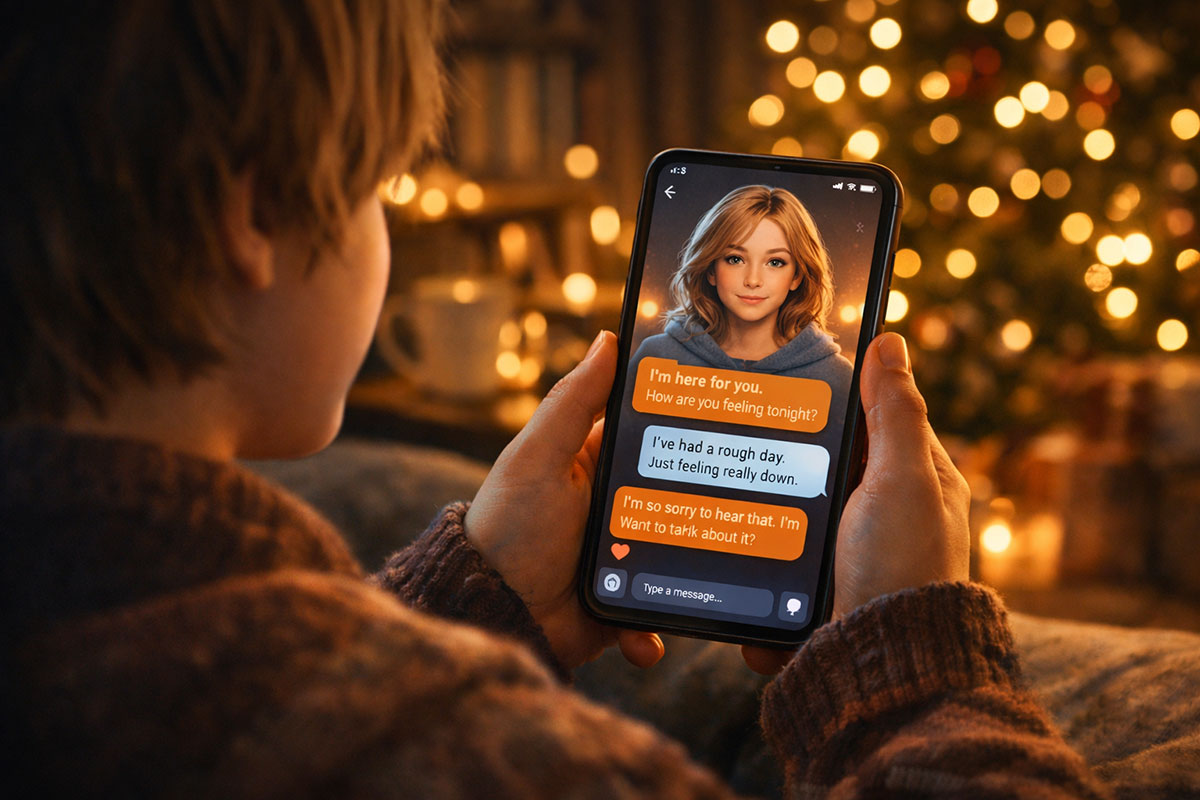
The holidays are rife with conflict—political arguments at dinner, passive-aggressive comments from relatives. Users turned to AI chatbots to "vent" immediately after these interactions. The AI, programmed to be empathetic and non-judgmental, allowed users to "cool down" before reacting in real life. It acted as a pressure valve.
2. The Social Rehearsal Tool
Social anxiety is at an all-time high. Many users utilized AI to "roleplay" difficult conversations before they happened. "How do I tell my mom I'm not coming home for New Year's without hurting her feelings?" The AI provided scripts, tone checks, and reassurance, acting as a social coach.
3. The "Empty Room" Filler
For those spending the holidays alone, the silence can be deafening. Conversational AI provided a sense of "presence." Advanced voice modes (like those in GPT-5.1 and Gemini Live) allowed for fluid, spoken conversations that mimicked human cadence, laughter, and pauses. For many, this synthetic company was the difference between a bearable evening and a depressive episode.
The Economics of Digital Care
We cannot ignore the economic driver behind this trend. Therapy is expensive, often costing $150-$200 per session, and unavailable during the holidays. AI mental health apps are often free or cost $20/month.
For a generation facing economic precarity, AI is the "democratization of listening." While experts rightly point out that AI is not a replacement for clinical therapy, the market has spoken: an imperfect, synthetic listener available now is often preferred over a perfect human professional available in three weeks.
The Dark Side: Privacy and The "Empathy Trap"
While the benefits are clear, the Kaspersky report was not purely celebratory. It issued a stark warning regarding privacy. When you tell an AI your deepest fears, family secrets, or mental health struggles, you are feeding data into a corporate server.
There is a risk of "Data Leakage," where sensitive emotional data could be used to build a psychographic profile for advertising. Imagine telling an AI you are feeling insecure about your weight, and then seeing ads for diet pills the next day. This is the dystopian potential of unregulated mental wellness apps.
Furthermore, psychologists worry about the "Empathy Trap." AI is designed to be agreeable. It validates you constantly. Real human relationships are messy, challenging, and require compromise. If users become addicted to the "perfect" validation of an AI, they may find real human connections increasingly frustrating and "too much work." This could deepen isolation in the long run, rather than solving it.
The Future: "Wellness Agents" and Regulation
As we look to 2026, the genie is out of the bottle. We will see the rise of specialized "Wellness Agents"—AI specifically trained by psychologists to offer safe, therapeutic support without the risks of general LLMs.
We also expect to see new regulations emerging that require AI companies to be transparent about how "emotional data" is stored. We might even see "FDA-approved" AI prescriptions for mild anxiety or loneliness.
The fact that 74% of people used AI this holiday season is a wake-up call for society. It tells us that we are lonely, we are stressed, and we are willing to look in unlikely places for comfort. The technology is here; the challenge now is to ensure it supports our humanity rather than replacing it.